The sacrifice was not in vain: We survived—we won! May their souls continue to rest in heaven. The Sun has risen. “Chi efoole”:
MO ENE
From the blood splashes
Of every human species
On sacred Earth’s grass
The Sun shall again rise.
(Beyond Biafra, May 30, 1997, KWENU, p. 5)
Before Biafra, we were Nigerians. In Biafra, Nigeria was everywhere. After Biafra, Nigeria is everywhere. Beyond Biafra, in any century AD, Nigeria will still be googled. We cannot escape the shadow of lands around River Niger (“Osimmiri Ojii”) —the cradle of Nok civilization. Names come and go; some are reused (Ghana, Mali, Egypt… Songhai); and some stick around in changed configurations (Aro, Bini, Bornu, Kongo, Israel, Oyo, Palestine, Sudan, Zamfara, etc.). Biafra existed as “Biafara” in precolonial maps before the supposed Iberia-Ijaw form we now use. (See “Of Bịafara and Bịanka”)
Prewar, my native Enugu was fun, clean Coal City with water all over. Babangiri, C-to-C, and Udoye big buses and black Morris Minor taxis plied the long-stretch Agbani Road, Zik Avenue, Okpara Avenue, Ogui Road, Abakaliki Road, Chime Avenue…. Some weekend evenings, family movies were shown in open fields. Only adults went to the cinema on Zik Avenue by Leventis, or by Tinker—owned and operated by our Lebanese neighbor, Mr. Solomon (a.k.a. Operator). I never noticed electrical power failure. No stray animals. No one got lost. No kidnapping. No armed robbery. No daredevil thieves. No trash on roads. Majestic masquerades thrilled at events. Oh, I still miss those church bazaar treats!
Life was simple and straightforward. Well, we were shielded from horrible stories in primary school. The teachers taught us grammar and arithmetic. The priests preached scripted Sunday sermons, no holy ghost fires, and no political pandering with tirades. Life was good. Kingsway ice creams were made in some new heaven—not New Haven, Enugu! We dreamed of boarding school in a couple of years, even when many parents could not afford the fees—just have a head for books; “ísí akwụkwọ”! I believed.
Coup. Countercoup. Pogrom. Gowon. Ojukwu. Aburi Accord. States. Biafra. War! The dream died. Boys Company. Saboteurs. Air Raid. Troops north, west, and south. Enugu fell to the Feds. We evacuated via Ozara-Udi bypass. Milken Road was a no pass. A close encounter with Nigerian soldiers produced a fatality, someone I knew.
I was with Grandpa. I was sad with mixed emotions. I left home and rejoined Biafran forces. I chose to shoot back than get shot on my knees. There was a genuine fear of genocide. The Pogrom was an hors d’oeuvre of 50,000 men, women, and children butchered like unwholesome Christmas chickens up North and out West. For a boy who had no understanding of death or even life, I chanted with adults: “Today, today: tomorrow no more; if I die today, I will die no more.” It was my rite of passage, my initiation into premature adulthood.
The war was not all about death and destructions. The human spirt was challenged. Good people become better; bad ones saw life in different shades. Few bad apples lingered. Evil came from the air. In Russian Ilyushin jets, panicky Egyptian pilots chose soft targets. They planned to live and spend their blood pay. So, instead of shooting “enemy four legs” (goats) at Lokpanta, we wait to shoot at jet fighters, if only to scare away the metallic kites killing our people in churches and at open markets in Awgu.
I still do not recall how I got to Orumba! PTSD? Small shellshock? The brigade major (BM) ran the show at 53 Biafran Brigade Ajalli, ably supported by the father of the base, a man mountain called RSM Ugwuanyi. As “Nwa BM,” with my “Madison” gun on my back, and seated on my Mobylette motorcycle, I rode and ruled the Ekwuluobia-Umunze stretch. No one dared me: “Biko, chaa; ị na-achọ ọnwụ!”… You wan’ die! LOL!
Just off the road at Umuogem and Enugu Abor villages of Ufuma, serious battles raged. We visited often, whenever federal troops made moves to cross Mmam River, especially with those huge-biceped and tall “gwodogwodo” mercenaries. The feds never succeeded. On our way back from the blood-soaked warfront down the road, we would stop at Madam Nwokolo’s famous Pentecostal church and grab some grub. It was a “relief materials” outlet. She and BM were related somehow. We still subscribed to then Bishop Arinze’s leadership. He issued communions and confirmations. Trust Catholics.
The Brigade HQ was a primary school. It had a shooting range, an oil refinery, a guard room, a court chaired by Dr. Uzoaga (he signed the Biafran currency with Dr. Ugo), and a Mami market. Mama Ékwutọsị and family were refugees from Anioma; she traded at Mami, had little—as all refugees from afar, but she took me in as her son and prayed for us all. I never saw where they lived!
Further up the main road was Basden Memorial school, Isulo (Isu ụlọ?), where I was sent to learn French and eventually get airlifted out to Gabon. I walked. I enlisted formerly, trained at Ụmụkaabịa, Okigwe—under Colonel Joe Achuzia’a 52 Div. I preferred to hang with the big boys than flee! I promised Grandpa that I will fight back. With my double magazine of bullets plugged into my metal-butt “Madison” (a junior AK-47), I feared no evil. The brigade commander, Lt. Col. Linus Iheanacho, who replaced Col. Nsudo, was only 25. If I got to 25, I could get my own brigade!
I was at the military hospital in Nawfija, just up the road from Ajalli, to see an officer who allegedly shot himself in the hand. As I was leaving, I saw a truck bringing in bodies. It was normal after “heavy fights.” I walked to the mortuary and opened the door. My God! See dead bodies chilling on the cold morgue floor and waiting to be processed and buried honorably. I promised that if I survived the war, I would tell their story.
I survived. To mention “Biafra” was taboo; when the press must, it was in quotes! Gowon was so bent on erasing Biafra he even denied his first son from an Igbo princess. We let him be. An Igbo roommate at Sandhurst avoided him to this day! The first law of nature kicked in: self-preservation. The 3Rs were words of the mouth. Long story short: I barely made it to, and out of, secondary school, trekking long distances across hostile villages, but I still did two ‘missionary journeys’ to Europe and taught college in my 20s. I missed the brigade command, but I served NYSC at Jaji, Kaduna—Nigeria’s military postgraduate institution.
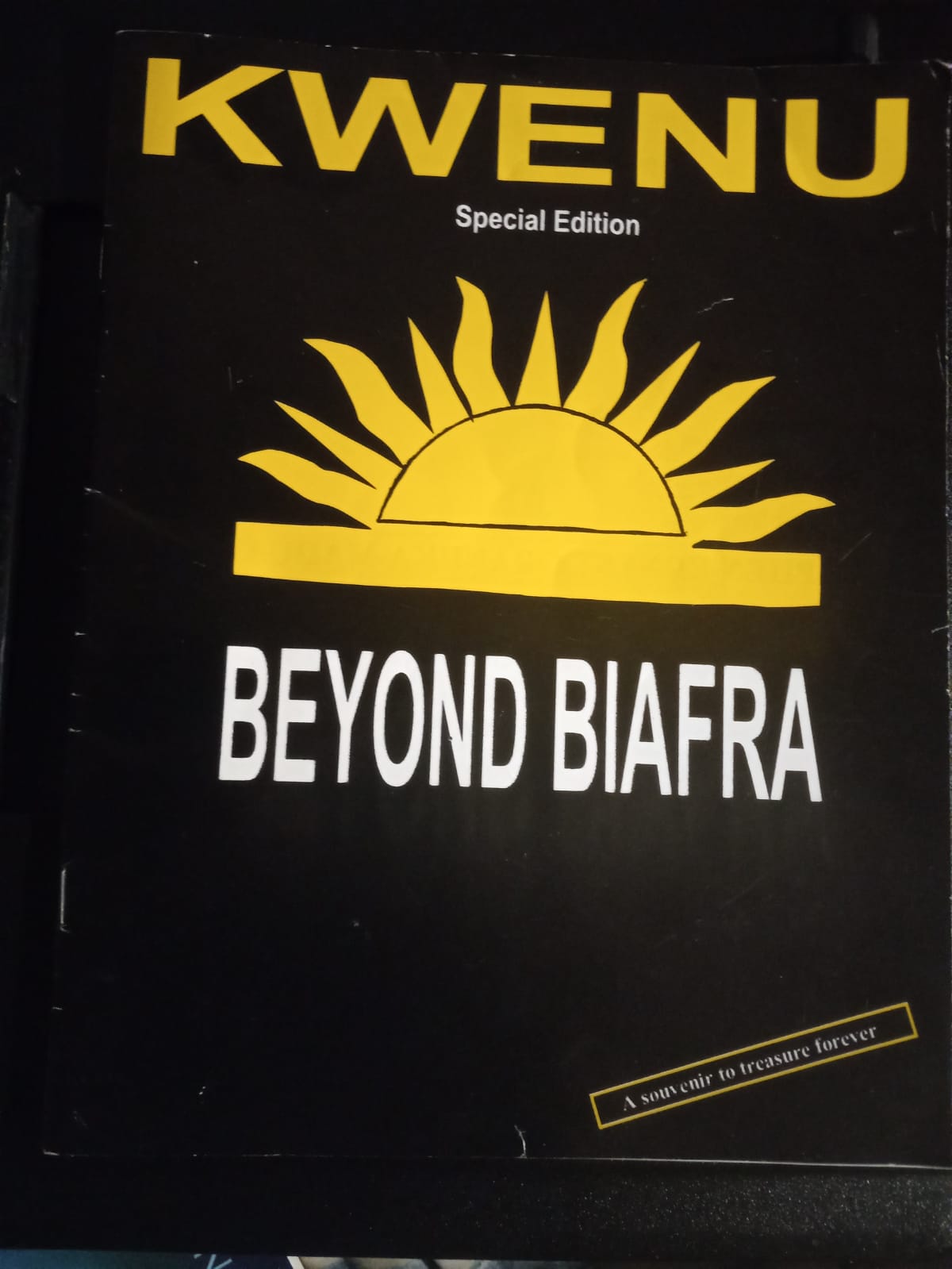
Twenty-five years ago, on Biafra’s 30th anniversary, I told the story in “Beyond Biafra” and made the month of May the Igbo Heritage Month! Copies of the magazine still exist in pristine form. I inaugurated the Nigeria-Biafra War Memorial Lecture series for folks to tell their stories, the stories of those brethren who gave their lives for our humanity and survival. I later raised money and reached out to the veterans of the war at Oji River. World Igbo Congress took over the program in Y2K. It crashed within a couple of years. The rest is history.
Within months, those who thought that anyone who broached Biafra would disappear into thin air got comfortable. Biafra began to flow in the mouth. By December 1997, Abacha’s Nigeria got worse. Biafra began to look and sound better. I published a piece that contained the famous line: “Nigeria as-is is unsustainable; Biafra as-was is unattainable.” Solution: Work with the six-zone structure and build a model Igbo-speaking nation: a solar spot to dissipate the darkness of Nigeria and beyond… a risen sun! Call it “The Dot; it may be what Nigeria needs to shine!

A second bloody confrontation is counterproductive and unnecessary, I argued. The first one was not our war, yet we fought it. Never again! In 2022, the second round has not started, and we have many crippled citizens and a cowed country with intractable insecurity. “Ka fune fune di etu à, kedu ka fụna-fụna ga-adị.” Who wants Somalia in Igboland? Who will tell the story of nameless, faceless youths who die for nothing?!
“Agarachaa must come back.” We are back to 1999. Wasted two decades and three years. Quo vadis? Which way? Watch a woman selling baskets of wet cassava flour (“akpụ”) in a village market. If the sun heads west and one basket is not sold, she retails it. It sells out fast and at a better profit. We call it “restructuring”! Using what we have handy to get what we want. It is not what happened to us but what we do with what happened to us. Biafra happened to us; what do we do with it? Kill some more people?
A bigger question is: “What do we want?”
We agree that Nigeria is not working as-is. We also agree that we do not have to keep doing the same thing and expecting different results. Enough of bloodletting! Let us stop the stale Nigeria-go-better rave! Let us build a stable and sustainable nation under any umbrella: stand-alone, in Nigeria—restructured or not, ECOWAS, AU, or globalized world economy. We can take the lead. We can choose a path less travelled. WE can build a better nation. Arewa, Bornu, Braced Midwest, and Oduduwa will pause and ponder all the years of intense Igbo antagonism. Beyond Biafra, we can still show why the revolution resonates, why the dead did not die in vain.
The renaissance starts with town governments for our communities. Check: It took a few weeks to stamp out the menace of “mkpụrụmmiri” (methamphetamine) in all Igbo communities bar none. Community policing was at work. Hopefully, two or more state governors will build a webbed world of these progressive communities across predominantly Igbo-speaking states—safe, secured, and stable. Simple solution? You bet!

This is the Aladimma Agenda: stepping slightly aside from the weak whole and doing first for ourselves. If we do not make this move soon, we will be consumed again by the freaky friction from the forced and fundamentally flawed federation of Nigerian nations, especially those whose dyed-in-the-wool hatred for Ndiigbo as a people has not receded a bit since 1900. Do we really want to pass this nongenetic disorder to another generation? Let’s turn the hate and fear to respect, if not love. Those who have no love cannot give love—they hate. Those who do not understand cannot learn—they fear. Respect is earned—let’s earn it with courage and knowledge in peace and prosperity. It is the principle of “akụ udo.”
Let’s remember today all those who shed the liquid of life in the murky mist of a senseless strife. It was senseless because we only wanted to survive; it was a war of survival. The sacrifice was not in vain: We survived—we won! No, we all lost—the victor and the vanquished. May their souls continue to rest in heaven… until we win the war.
The Sun has risen. “Chi efoole”: Let’s get back to work for our continued coexistence in a new national order dictated by innovations and productivity, not delegate dollars, coldhearted kidnappings, and callous killings. Enough already!

MOE, 5.30.2022
@aladimma
 aladimma.net