Elsie Onubogu
“The women of today are the thoughts of their mothers and grandmothers, embodied, and made alive”
~ Matilda Joslyn Gage.
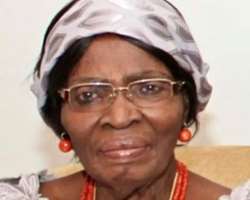
With deep nostalgia and profound gratitude, I pay tribute to a soft-spoken, extraordinary woman of integrity, modesty, and quiet strength: Professor Kamene Okonjo, a distinguished Professor of Sociology and Matriarch of the Ogwashi-Uku Kingdom – Delta State, Nigeria.
In her unassuming yet consequential way, she carried forward a generational baton and handled it with dignity, nurturing minds — as seen in her family lineage, challenging limitations, and mentoring countless individuals, making it her lifelong mission to ensure unbroken batons.
Her life and career reaffirm an unwavering commitment to education, equality, intellectual development, and human dignity.
Through her scholarship, mentorship, and personal example, she helped shape minds and inspire generations of individuals.
Her influence went beyond the classroom, extending into families, communities, and institutions around the world—promoting the enduring value of education and intellectual excellence.
She was, quite simply, an inspiration to many!
Professor Kamene’s life demonstrates that knowledge need not be loud to be influential, leadership need not be ostentatious to be effective, and modesty can be compatible with greatness—a regal title she carried as the Queen of Ogwashi-Uku with silent grace and no loud proclamation.
As a brief digression, Professor Kamene Okonjo belongs in that distinguished company of exceptional, world-class scholars I have been privileged to learn from.
My educational journey brought me into contact with her as a student of Sociology and Anthropology at the University of Nigeria, Nsukka (UNN).
At the time, the department featured three (3) exceptional female academics whose professional accomplishments deeply enriched the intellectual ecosystem:
- Professor Kamene Okonjo;
Professor Ada Mere; still graceful at 96 years old, and
- Professor Felicia Ekejiuba, of blessed memory on whose shoulders my career on diversities soared.
Their presence was a powerful statement about the place of women in academia and the transformative possibilities of female leadership within higher education and society in general.
In her class – Sociology of Education, Professor Kamene offered us more than academic lessons. She used every opportunity to open a window into the nexus between education and society, knowledge and opportunity, learning and human advancement.
She helped us realize that education goes beyond facts and qualifications; it shapes values, overcomes inherited limitations, and prepares individuals to contribute meaningfully to society.
In hindsight, I can attest that learning from a woman of her calibre was itself an education in excellence, discipline, humility, and service.
Beyond her academic contributions, she played a significant role in the wider university community.
As a leader of the National Association of University Women (NAUW) at UNN, she helped advance the interests of women and strengthen the visibility of their contributions to academic and public life.
Under her leadership, the association expanded platforms through which women’s concerns could be articulated, achievements recognized, and roles in institutional development more firmly established.
Such work was vital, as women’s contributions to society are too often overlooked, undervalued, or treated as secondary.
This laid the foundation for what the global Women’s Architecture later classified as “Unpaid Work.”
By elevating women’s issues within the university, she shifted the narrative: women were no longer seen as peripheral participants in development, but as essential builders.
Her leadership transcended mere representation.
It created an environment where women exercised their abilities, commanded respect, and drove social change.
Professor Kamene’s achievements matter.
Yet, for me, her true masterpiece is weaving an enduring legacy into an existing, much broader tapestry—extending a journey that began long before her.
This extension can be seen today in Dr. Ngozi Okonjo-Iweala, Dr. Njideka Okonjo-Udochi, Dr. Onyinye Iweala, and many others.
It is a journey shaped by generations of women who dared to challenge convention, shatter the proverbial glass ceiling, and weave the binding thread of women’s leadership across generations.
Auntie Kamene—along with a few others—did not drop the ball. This is why I am paying homage to this extraordinary woman – a key leader in the tapestry of multi-generational women’s leadership.
The generational connection is neither new nor accidental; it is a legacy forged by women who understood that progress is never the accomplishment of one generation alone.
Trailblazers like Queen Amina, Funmilayo Anikulapo-Kuti, Margaret Ekpo, Adamma Okpara, and Oyibo Odinammadu, among others, helped widen the path for those who followed.
Their courage and conviction remind us that every woman who rises stands, in part, upon the shoulders of those who came before her.
As women’s rights advocate Matilda Joslyn Gage stated: “The women of today are the thoughts of their mothers and grandmothers, embodied and made alive… and generations of women before us continue to speak through those living today.”
This is a profound reminder that we carry inherited battles, and must fight to make our societies better.
We honor these trailblazing women — in particular – Professor Kamene, for breaking barriers, opening doors, and creating spaces for dialogues on women’s leadership, equality, and human dignity.
Still, I think the greatest tribute we can pay to Professor Kamene is to continue her unfinished work: the dialogue she started on education as a mechanism to promote development, equal and equitable societies.
We must protect past gains and pursue progress with renewed determination.
Every generation inherits a responsibility not just to enjoy past breakthroughs, but to consolidate them and pass them forward.
Therefore, our responsibility must be to individually and collectively work to preserve values, transmit knowledge, and pass the baton of leadership to young people—in particular, women.
We must mentor as Auntie Kamene mentored: open and keep doors open for future generations, and ensure they inherit our progress rather than our struggles.
That is the true test of passing on the baton.
Those she taught, mentored, and inspired —including Professor Uche Amazigo, who served as the NAUW Secretary under her leadership—must now carry it forward.
Carrying and passing on the baton requires courage, humility, and servant leadership, for the battle for equality transcends generations and disrupts power structures.
Just as Professor Kamene did, we must faithfully pass it on with persistence and diligence.
In the final analysis, Professor Kamene was a pacesetter, an exceptional role model, and a woman whose legacy cannot be reduced to titles, professional accomplishments, or the distinguished lives of those she nurtured.
What I know for sure is that her true legacy resides in the barriers she helped to dismantle, the confidence she inspired in many, the minds she awakened, and the generations she prepared to take their place in the tapestry of human development.
Let us continue her work with the dignity and quiet strength she depicted.
May her life remain a testament to the power of quiet greatness, the enduring strength of women, and the unbroken chain of generations reaching toward a more just and equal world.
Auntie Kamene may have taken her final bow, but I am reassured that, with women like her daughter, Dr. Ngozi Okonjo-Iweala – the first woman Director General of the World Trade Organization WTO, the baton is devotedly passed on.

Elsie Onubogu
NomMSpEd©31October2026

